
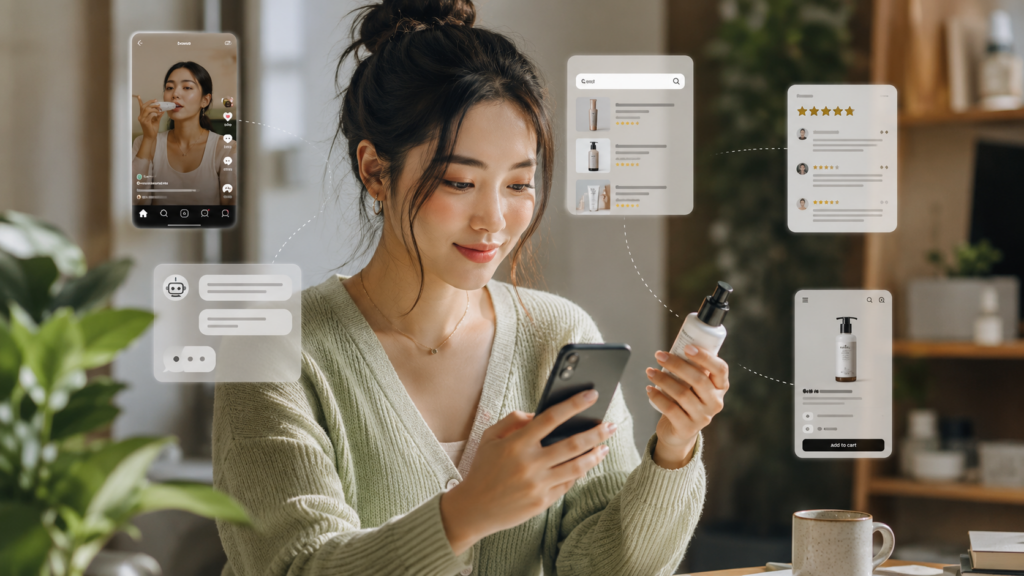
For years, when we have talked about reaching Gen Z, the conversation has quickly moved to social media. TikTok, Instagram, YouTube, creators and short-form video have all become central to how brands think about this audience, and rightly so. Social media remains hugely important for Gen Z.
But there is another behaviour growing alongside social that FMCG brands need to pay attention to. Gen Z are also using AI, and not simply to create content or answer questions. They are increasingly using AI to find things, research products, understand their options, compare brands and make decisions.
That has quite significant implications for how brands think about social, search, content and their own websites.
Gen Z hasn’t stopped using social. They’ve added AI.
One of the things we have a habit of doing in marketing is assuming that one channel is going to replace another. Google replaced directories. Social replaced Google. TikTok replaced Instagram. Now AI is going to replace search.
Customer behaviour rarely works quite like that. People generally add new behaviours to the ones they already have, particularly when each channel serves a slightly different purpose.
And the current data really shows that.
Salesforce found that 76% of Gen Z discover products through social platforms, while 54% have already used generative AI to discover or evaluate a product, compared with 39% of consumers overall.
McKinsey’s 2026 State of the Consumer research shows a similar pattern. 28% of Gen Z say they already use generative AI tools specifically for shopping, while 60% regularly use the AI Overviews appearing within traditional search.
So this is not a story about AI replacing social. It is a story about the customer journey becoming bigger, messier and more fragmented.
And for FMCG brands, that matters.
The numbers behind the shift
A few stats are worth pulling out because, together, they tell a very clear story:
- 76% of Gen Z discover products through social media — Salesforce
- 54% of Gen Z have used generative AI to discover or evaluate a product — Salesforce
- 28% of Gen Z use generative AI tools specifically for shopping — McKinsey
- 60% of Gen Z regularly use AI Overviews within traditional search — McKinsey
- AI-driven traffic to US retail websites grew 393% year-on-year in the first three months of 2026 — Adobe
- Visitors arriving from AI sources converted 42% better than non-AI traffic — Adobe
- AI-referred visitors also spent 48% longer on websites — Adobe
What I find interesting is that none of these stats suggest social has become less important. They suggest AI is being layered into the same customer journey.
Think about what a real customer journey might look like now
Imagine somebody sees a skincare product on TikTok. A creator talks about it, the packaging catches their eye and somebody in the comments says it helped with a particular skin concern. That might create the initial interest.
What happens next is where things are changing.
They might search TikTok for more reviews. They could Google the product. They might go to a retailer and look at the reviews. Or, increasingly, they might open ChatGPT or Gemini and ask something like:
“What is the best moisturiser for dry skin that won’t feel greasy?”
They might then ask:
“Which of these brands is best for sensitive skin?”
“Compare Brand A with Brand B.”
“Are there any downsides to Brand A?”
The important point here is that they have not necessarily searched for your brand. They have described a need.
That creates a very different marketing challenge.
The question is no longer simply:
Are we ranking for our keywords?
It becomes:
When somebody describes the problem our product solves, does AI understand enough about us to include our brand in the answer?
That is a question I think far more FMCG leadership teams need to be asking.
Social can create demand. AI can shape the consideration set.
This is also why I would not recommend that brands start taking money away from social and simply move it into “AI”. The channels are doing different jobs.
Social is brilliant at creating discovery, emotion, cultural relevance, recommendation and social proof. You see the product being used. You see somebody like you talking about it. You might even discover a problem you did not realise you had.
AI enters the journey differently. It can help somebody understand, compare, shortlist and evaluate. Increasingly, it can also recommend.
That means there is an important stage emerging between “I’ve seen something I’m interested in” and “I’m going to buy it”. AI can potentially shape which brands even make it into that consideration set.
And that is a significant change.
Which brings us back to the website
For several years I have heard versions of “Nobody really goes to brand websites anymore” or “Gen Z lives on social, so that’s where our content needs to be.”
There is some truth in that. Most FMCG websites are not somewhere consumers are going to spend hours browsing for fun.
But AI changes the role of the website because, even if your customer does not read every page, an AI system may still be trying to understand what is on it.
Your website is one of the places where you can clearly explain what your product is, what problem it solves, who it is designed for, its ingredients, benefits, usage, claims, evidence, variants and frequently asked questions.
That information matters because it helps search engines and AI systems understand your brand.
McKinsey also makes an important point here. Generative AI platforms are drawing on a much wider ecosystem than a brand’s own content, including forums, retailer reviews, blogs and video platforms. If the signals about a brand are incomplete or contradictory, AI can struggle to represent that brand accurately.
So the website is not the whole answer, but it is one part of the answer that brands can actually control.
And people coming from AI appear to behave differently
We are also beginning to see AI turn into an actual source of website traffic.
Adobe reported that traffic from AI sources to US retail websites increased 393% year-on-year during the first three months of 2026.
What I find even more interesting, though, is what those visitors did when they arrived.
In March 2026, Adobe found that visitors arriving from AI sources converted 42% better than non-AI traffic. They also spent 48% longer on websites and viewed more pages.
That makes sense when you think about the behaviour.
Somebody may already have spent ten minutes talking to an AI about their needs. They may have researched, compared and narrowed their options before they ever arrive on your site. By the time AI sends them to a brand or retailer website, they can be arriving with considerably more intent.
So dismissing the website because “our Gen Z audience is on TikTok” could become quite an expensive assumption.
This isn’t just SEO with a new acronym
I also do not think the response should simply be: “Right, we need to do AEO.”
That risks turning another customer behaviour change into another technical marketing checklist.
Yes, SEO matters. Structured content matters. Schema matters. Technical accessibility matters.
But the bigger question is whether there is enough useful and authoritative information about your products and your brand across the digital ecosystem for an AI to confidently understand you.
That means your website, retailer content, reviews, PR, social content, creator activity, forums, expert content and product data all start contributing to the story an AI sees.
This is also why organisations that treat social, ecommerce, SEO, content, PR and digital shelf as completely separate functions could find this increasingly difficult.
The customer does not respect your organisational structure, and AI certainly does not.
Content now has two audiences
There is another interesting implication in all of this.
For years we have been told that people do not read. Keep the copy short. Reduce the words. Put it into a Reel. Make everything snackable.
There is still absolutely a place for that.
But there is also a growing need for detailed content, because content now increasingly has two audiences.
The human needs to quickly understand whether something is relevant to them, whether they trust it and why they should care.
The machine needs to understand exactly what the product is, who it is for, what problem it solves, how it is different, what evidence supports its claims and when it should be recommended.
That does not mean filling websites with thousands of words of generic AI-generated content.
Quite the opposite.
It means creating genuinely useful information that answers real customer questions properly.
For FMCG brands, this could change the role of product content significantly
Think about a fairly traditional product detail page.
Product image. Product title. Three benefits. Ingredients. Add to basket.
Now think about the kinds of questions somebody might actually ask an AI.
What is the difference between these two products?
Can I use this every day?
Is this suitable for curly hair?
Which product in the range should I choose?
What does this ingredient actually do?
Is this suitable for sensitive skin?
What is the best alternative if I do not want fragrance?
Which one gives me the best value?
Suddenly the information sitting behind the product becomes much more commercially important.
This is something digital shelf teams should be thinking about now. Not just, “Is my product page optimised for the retailer search algorithm?” but also, “Does my content clearly answer the questions a customer might now ask an AI?”
The customer journey is not a funnel anymore
We have known this for years, of course, but AI is making it even more obvious.
A Gen Z customer might see something on social, use AI to understand their options, move into search or retailer sites to validate those options, visit a brand website for more detailed information, go back to social or creators for reassurance and then finally buy.
They may also go backwards and forwards through those stages several times.
Google is still part of that journey. Social is still part of it. Retail media is still part of it. AI has simply added another very powerful layer.
That is why I think the phrase “Gen Z has moved from social to AI” is the wrong way to think about what is happening.
Their customer journey has simply got bigger.
So what should FMCG brands actually do?
I would start with the customer rather than the technology.
Take one of your priority products and ask:
What would somebody who does not know our brand ask if they were trying to solve the problem this product solves?
Then actually ask those questions in ChatGPT, Gemini, Google AI Mode and any other relevant platforms.
What brands appear? Does yours? How is it described? Which sources are being used? Where is the information coming from? What appears to be missing?
Then look back across your own ecosystem.
Can somebody, human or machine, easily understand what your product does, who it is for and why somebody should choose it?
If the answer is no, I would fix that before worrying about the latest AI optimisation tactic.
Because ultimately, this is still customer centricity.
The technology might have changed. The fundamental principle has not.
Understand where your customer is going for information, understand the questions they are asking, and make sure your brand is genuinely useful when they get there.
That is the bit I think matters most.
Gen Z has not moved from social to AI. Their customer journey has simply got bigger.
Cognitive Union works with large B2C and B2B businesses to build the commercial skills, digital fluency and customer-first thinking their teams need to perform — closing the capability gaps that sit between where teams are today and where the business needs them to be.
Lead. Don’t follow.
Find this blog useful? Sign up to our email newsletter (bottom of this page) where you can receive articles like this and other insights (not publicly published), and you can also follow us on LinkedIn.