
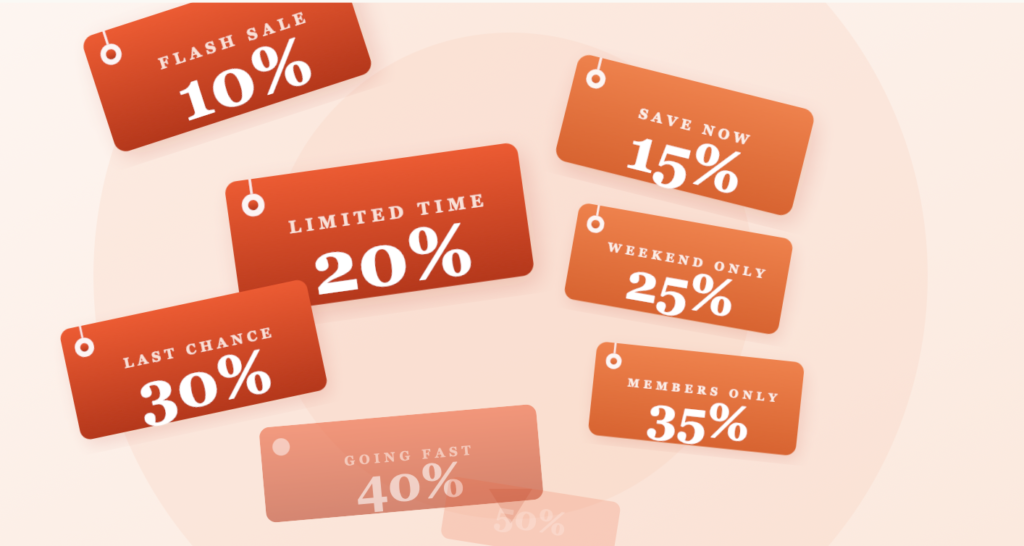
For years, brands trained their customers to wait for a deal. Now the deal is the brand. And that’s a problem nobody quite knows how to undo — especially as the pressure to consolidate, merge and cut costs strips away the last traces of what made them worth buying in the first place.
Open your inbox. Go on, do it now. Scroll through the emails from the brands you’ve bought from in the last six months. How many of them are offering you something — a percentage off, a flash sale, a loyalty reward, a “because we miss you” discount code? How many of them are telling you something genuinely interesting about their product, their values, or why you should care about them beyond the price point?
For most brands in the CPG and digital commerce space, the answer is uncomfortable. The inbox has become a discount distribution channel. And the brands sitting inside it have, largely, forgotten how to talk about anything else.
How did we get here?
The race to the bottom didn’t happen overnight. It happened deal by deal, quarter by quarter, as teams under pressure to hit short-term conversion targets reached for the easiest lever available. Discount. Promote. Repeat.
It worked — in the narrow sense. Click-through rates ticked up. Basket sizes grew. Revenue looked respectable on a dashboard. But underneath that dashboard, something more damaging was happening: brands were training their customers. They were teaching them that full price is a mistake. That patience pays. That if you wait long enough, the deal will come.
And customers, being rational, learned quickly.
“The brands that are struggling most right now aren’t losing on price. They’re losing on meaning. Customers simply don’t know what they stand for — beyond being cheaper than last week.”
Now those brands are trapped. Pull back on discounts and volume drops. Keep discounting and margin erodes. There’s no obvious way out — especially for brands that never built a strong enough personality, or a deep enough relationship with their customers, to withstand the pressure.
The tolerance problem nobody’s talking about
There’s a concept in pharmacology called drug tolerance: the more you expose someone to a substance, the more of it they need to get the same effect. Discount tolerance works exactly the same way. Ten percent off used to feel generous. Then customers needed fifteen. Then twenty. Then a free gift with purchase. Then free delivery on top of that.
The brands caught in this cycle are finding that their promotional mechanics are working harder and harder for less and less return. Acquisition costs are rising. Retention is fragile. And the customers they’re attracting are, by design, the ones most likely to leave the moment a competitor offers a slightly better deal.
This is not a traffic problem or a conversion rate problem. It’s a brand equity problem. And it’s been building for years in plain sight.
- 2 in 3 shoppers actively hunt for discounts or lower prices before buying Intelligence Node (Consumer Behavior Report 2024)
- 5–25× more expensive to acquire a new customer than retain an existing one (Harvard Business Review / Bain & Company)
- 82% of shoppers want a brand’s values to align with their own (Harris Poll / Google Cloud, 2022)
What values-led brands understand that others don’t
While many brands have been busy engineering their next flash sale, a different kind of brand has been quietly doing something harder and more valuable: standing for something.
Patagonia is the most cited example for good reason. It has built one of the most loyal customer bases in the world not by competing on price, but by competing on conviction. Its environmental mission isn’t a marketing add-on — it’s structurally embedded in how the business operates, what it makes, and how it talks to its customers. When Patagonia tells you to buy less, or repairs your jacket for free, or donates its profits to environmental causes, it isn’t being eccentric. It’s being consistent. And consistency, over time, is what trust is made of.
But you don’t need to be a billion-dollar outdoor brand to understand this principle. Consider Norfolk Natural Living — a small, independently run British brand built around natural home fragrance and skincare. No celebrity endorsements. No enormous paid acquisition budget. What it has instead is something far more powerful and far harder to replicate: a genuine personality.
Norfolk Natural Living has mastered what most large brands can’t buy at any budget — the art of being personal at scale. The founder’s voice comes through in every touchpoint. The brand feels like a conversation rather than a broadcast. Customers don’t feel like they’re on a CRM list; they feel like they’re part of something. There’s a warmth, a sense of place, a story rooted in the Norfolk landscape that makes every product feel considered rather than commoditised. People don’t just buy the candle or the hand cream. They buy the feeling of belonging to a brand that shares their values — a quiet life, natural materials, things made with care. And because that emotional connection is real, they return. Not because there’s a discount waiting for them, but because the brand has earned their loyalty through who it is, not what it costs.
“The secret isn’t the product. It’s the feeling that someone who genuinely cares made it — and that by buying it, you’re part of that world too.”
This is the secret sauce that large CPG brands so often acquire and then accidentally destroy: the sense that there is a human behind it. That someone cares. That the brand has a point of view beyond margin targets and promotional calendars.
Patagonia – Built on environmental conviction. Customers buy the mission, not just the jacket. Loyalty follows values, not price.
Purpose-led
Norfolk Natural Living – Personal at scale. Provenance, place and a founder’s voice at every touchpoint. Full-price buyers who return for belonging, not bargains.
Story-led
The discount-first brand – No clear values. No emotional hook. Inbox full of percentage-off codes. Customers who leave the moment someone beats the price.
Promotion-led
These brands share something that no promotional calendar can manufacture: people align to them. Not just as customers, but as believers. They recommend without being asked. They feel something when they use the product — a quiet confirmation that they’re supporting something that matters to them. And crucially, research backs what intuition tells us: 64% of consumers say they would pay more for brands that reflect their values (Givsly, 2025). That premium isn’t hypothetical. It’s sitting there, unclaimed, by any brand willing to do the work of standing for something real.
The brand experience gap: where online lost its soul
There is a moment that every shopper who has ordered from Norfolk Natural Living will recognise. The parcel arrives. And before you’ve even opened it, something feels different. The packaging is considered — not just functional. There’s a handwritten-style note, and more often than not a small something extra: a sample hand moisturiser, a little gift you weren’t expecting. It doesn’t cost much. But it signals everything. Someone thought about this. Someone cared about the moment you opened the box, not just the moment you clicked buy.
This is brand experience done properly. And it is, quietly, one of the most powerful commercial tools available to any brand selling online — because it turns a transaction into a memory.
Large brands understood this in the physical world. Department stores, boutiques and premium independents spent decades perfecting the in-store experience: the tissue paper, the ribbon, the staff who remembered your name, the complimentary sample tucked into the bag. These weren’t accidental touches. They were deliberate signals of respect for the customer — a way of saying that your purchase mattered, that you mattered, and that the brand valued the relationship beyond the sale.
When commerce moved online, most of that craft was left behind. And the culprit, more often than not, was a cost conversation. Branded packaging costs more than plain brown boxes. Personalised order confirmations take time to write. Product samples cut into margin. So they went. Replaced by automated emails, generic unboxing and a transactional efficiency that left no room for delight.
The loss is bigger than most brands realise — and the opportunity for those willing to reclaim it is significant.
Consider what Norfolk Natural Living does from the very first digital touchpoint. The website feels like stepping into a place — calm, considered, rooted in landscape and provenance. The email confirmation after you purchase doesn’t feel like it came from a system. It feels like it came from a person. By the time your order arrives, you’ve already been looked after twice before you’ve touched the product. And then the packaging of the products themselves becomes part of the experience: beautiful enough to keep, considered enough to photograph, personal enough to share.
That shareability is not incidental. It is the modern equivalent of word of mouth — and it costs a fraction of paid acquisition. When a customer photographs their Norfolk Natural Living unboxing and posts it, they are doing the brand’s marketing for it. Not because they were incentivised. Because the experience was genuinely worth sharing.
This is the brand experience gap that most large CPG brands are sitting on without realising it. The in-store craft that built their loyalty — the samples, the theatre, the sense that someone cared — has largely vanished from their digital commerce operation. Email confirmations are automated and generic. Packaging is optimised for cost-per-unit. The unboxing moment, which for some categories is the single most emotionally resonant touchpoint in the entire customer journey, is treated as a logistics problem rather than a brand opportunity.
The brands that close this gap — that bring the warmth, the personalisation and the physical delight of the best retail experiences into their digital channel — will find something unexpected waiting for them on the other side: customers who remember them, return without being prompted, and tell other people without being asked.
That is not a marketing strategy. That is what a values-led brand feels like from the inside. And it cannot be faked, replicated by a competitor overnight, or undercut by a discount.
A word on discounting — because nuance matters
This isn’t an argument against ever discounting. End-of-line clearance, end-of-season sales, genuine loyalty rewards for your best customers — these are legitimate, well-understood commercial tools. Used deliberately and sparingly, they serve a purpose. The problem isn’t the discount itself. It’s when the discount becomes the default; when it replaces strategy rather than serving it. A brand that discounts selectively and with purpose is a brand in control. A brand that discounts reflexively, constantly, because it has no other story to tell — that’s a brand in trouble.
First-party data: the asset brands don’t use
Here’s the deeper irony. Many of these brands have been operating in digital commerce long enough to have accumulated something genuinely valuable: customer data. Behavioural signals. Purchase histories. Preference patterns. The raw material of genuine, personalised customer relationships.
But that data is sitting largely unused — or worse, being used only to time the next discount email more precisely. We’ve seen brands with sophisticated CRM infrastructure deploying it almost exclusively in the service of promotional mechanics. The technology is there. The ambition isn’t.
Smart brands use first-party data to do something fundamentally different: to understand what their customers actually value, and to build communication strategies around that. Not “here’s 20% off because it’s Tuesday.” But “here’s a product we think you’ll love, based on what you’ve bought before, and here’s why it’s worth paying full price for.”
That’s the difference between a transactional relationship and a loyal one. And in a world where third-party cookies are gone and paid acquisition keeps getting more expensive, the brands that have invested in genuine customer understanding are pulling away from those that haven’t.
Product showcase is the missed opportunity
Walk into any well-run physical retail environment and you’ll see something digital commerce has largely forgotten: the art of the product showcase. The way something is presented, contextualised, demonstrated — it changes how it’s valued. A product positioned beautifully, with its story told well, commands a different price in the customer’s mind than the same product slapped on a promotions page next to a countdown timer.
Digital commerce has the tools to recreate this. Video. Storytelling. Editorial content. User-generated proof. Personalised recommendations grounded in real data. The channels exist. The creative capability exists. What’s often missing is the conviction — the willingness to trust that customers will pay full price for something they genuinely believe in, if you take the time to make them believe in it.
The brands doing this well are not the ones with the biggest promotional budgets. They’re the ones with the clearest sense of who they are, who their customer is, and what they stand for beyond the transaction.
The consolidation threat: when the acquirer kills the soul
There is a troubling pattern accelerating across the industry right now. Smaller, values-led brands — often the ones with the most loyal customer bases and the clearest identities — are being acquired by larger players. The motivations are understandable: cost reduction, access to data, distribution capability, and the commercial pressure that comes with operating independently in an increasingly expensive environment.
But something often gets lost in the transaction. The very things that made the smaller brand worth acquiring — its personality, its community, its sense of purpose — are precisely the things most vulnerable to corporate integration. A brand that grew because its founder cared deeply about where its ingredients came from can quickly find, post-acquisition, that sourcing decisions are now made by a procurement team optimising for margin. The community that built itself around shared values notices. And quietly, it leaves.
We are seeing more and more of this: beloved independent brands absorbed into larger portfolios, stripped of their distinctiveness, and eventually hollowed out into just another SKU on the shelf. The larger brand gets the customer list. It rarely gets the loyalty. Because loyalty was never to the product — it was to what the product represented. And that doesn’t transfer in a deal sheet.
“Loyalty was never to the product — it was to what the product represented. That doesn’t transfer in a deal sheet.”
The Harris Poll data makes this stark: three-quarters of shoppers say they have parted ways with a brand over a conflict in values (Harris Poll / Google Cloud). Post-acquisition brand drift — however gradual — is exactly this kind of conflict, playing out slowly over months and years until the community that built the brand has quietly moved on to the next independent that feels like the original did.
For larger brands looking to grow through acquisition, this is a critical strategic lesson: the asset you are buying is cultural, not just commercial. Protect it accordingly. For smaller brands navigating merger conversations, it’s an equally important one: your values are not a soft differentiator. They are your most defensible commercial asset. Treat them as such in any negotiation.
What smart brands do instead
Getting out of the discount trap is genuinely hard. It requires a tolerance for short-term pain, leadership alignment, and — critically — the capability within commercial, marketing and digital teams to execute a different kind of strategy. But it is possible, and the brands that make it through come out with something their competitors can’t easily replicate: a loyal customer base that buys on value, not on price.
The brands pulling ahead are doing a handful of things differently. They’ve done the hard work of articulating what they actually stand for — not in a brand guidelines document that nobody reads, but in the texture of every customer interaction, every product decision, every email they send. They use first-party data not just for targeting, but for genuine insight into what their most valuable customers care about. They’ve rebuilt their digital commerce experience around product stories rather than price signals. And they’ve developed the internal capability to sustain all of this — because a strategy is only as good as the team that can execute it.
Most importantly, they’ve accepted a fundamental truth that values-led brands like Patagonia and Norfolk Natural Living have always known: discounts attract customers. Brand attracts advocates. And advocates are the only ones who will still be there when someone else offers a cheaper deal.
“Discounts attract customers. Brand attracts advocates. Only one of them stays when a competitor cuts their price.”
The capability gap at the heart of it
Underlying all of this is something that rarely gets named in conversations about brand strategy and digital commerce: a capability gap. Teams that were built for a world of promotional mechanics are not automatically equipped to execute a customer-centric, values-led, data-informed brand strategy. The thinking is different. The skills are different. The way you measure success is different.
That’s not a criticism of the people involved — it’s a reflection of what they were hired and trained to do. But if the strategy is changing, the capability has to change with it. And that requires deliberate investment: in the right programmes, the right thinking frameworks, and the right external challenge to help teams see past the assumptions that got them into the discount trap in the first place.
The brands that will look back on this period as a turning point are the ones that treat it as exactly that — not a crisis to be managed with another promotional push, but a moment to build something better. A brand worth paying full price for. A customer relationship worth having. A values system that people actually want to align to.
That’s not idealism. That’s strategy.
Cognitive Union works with large B2C and B2B businesses to build the commercial skills, digital fluency and customer-first thinking their teams need to perform — closing the capability gaps that sit between where teams are today and where the business needs them to be.
Lead. Don’t follow.
Find this blog useful? Sign up to our email newsletter (bottom of this page) where you can receive articles like this and other insights (not publicly published), and you can also follow us on LinkedIn.