
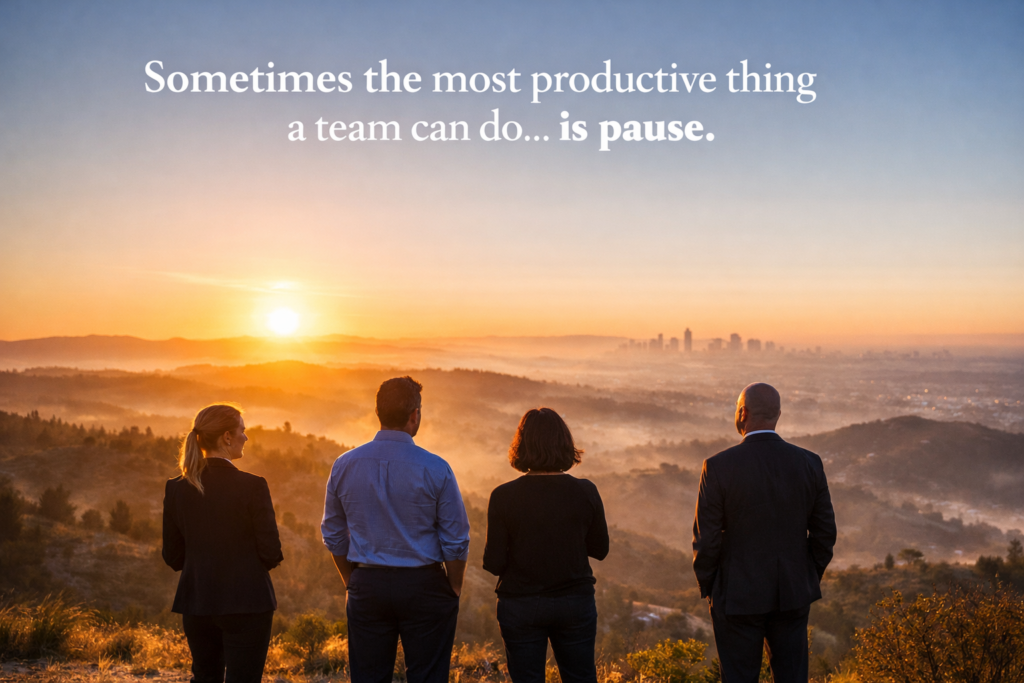
It’s Not Just the Learning. It’s the Thinking Space.
Over the past few months, I’ve been delivering a number of leadership and digital transformation programmes for global organisations.
Most of them follow a blended format.
A face-to-face kick-off.
Virtual sessions that follow.
Sometimes a final in-person lab to bring everything together.
It’s a structure that works.
But something interesting has been happening in the room.
Something the organisations investing in these programmes weren’t fully expecting.
We All Knew Face-to-Face Was Valuable
Let’s start with the obvious.
When people come together physically:
- Conversations happen more naturally
- Relationships build faster
- Ideas flow more freely
That part isn’t new.
We’ve known for years that learning accelerates when humans interact properly.
But since COVID, many organisations discovered something else.
Virtual training is cheaper.
Faster to organise.
Easier to schedule.
So the pendulum swung.
And for a while, everything moved online.
But Here’s What Teams Are Saying Now
In the past few weeks, I’ve heard the same comment repeatedly from senior teams attending face-to-face sessions.
Not once.
Not twice.
Over and over again.
“We were nervous about taking time out to attend this.”
Because like every organisation right now, they are busy.
Targets.
Transformation projects.
AI conversations.
Commercial pressure.
Tight budgets.
Everyone feels they need to be doing more.
Working harder.
Moving faster.
Responding quicker.
So stepping away from the day-to-day can feel uncomfortable.
Almost indulgent.
Until they experience it.
The Hidden Power of Stepping Out
When people commit to face-to-face learning, something subtle but powerful happens.
They step out of the operational whirlwind.
No inbox.
No back-to-back calls.
No constant context switching.
Just time to think.
Properly think.
Not firefighting.
Not reacting.
But taking a helicopter view of:
- What they are trying to achieve
- Where the organisation is heading
- What actually matters
And suddenly the classic phrase becomes real again.
Work smarter. Not harder.
Because sometimes the most productive thing you can do…
Is pause.
Breaking the Organisational Bubble
There’s another moment that always stands out during face-to-face sessions.
At the start of the day, people naturally sit with the people they know.
Same region.
Same team.
Same department.
Human nature.
So during exercises I do something simple.
I ask them to stand up.
Find someone they don’t know.
Different region.
Different function.
Different perspective.
And every single time, something interesting happens.
People realise they are not alone in their challenges.
The same barriers appear across markets:
- Internal silos
- Resource pressure
- Competing priorities
- The pace of change
Suddenly the room becomes a learning network.
Ideas start travelling across regions.
Solutions surface from unexpected places.
And people leave with something they didn’t expect.
Not just knowledge.
But connection.
The Real ROI of Face-to-Face Learning
Yes, face-to-face training requires investment.
But the real value isn’t just in the content.
It’s in what it creates.
Space.
Perspective.
Connection.
Three things that are increasingly rare in busy organisations.
And yet those three things are often exactly what teams need to move forward.
A Final Thought
When organisations invest in face-to-face learning, they’re not just buying training.
They’re giving their teams something far more valuable.
Permission to pause.
Time to think.
And the chance to learn from each other.
In a world moving faster than ever…
That might just be the smartest investment a business can make.
Cognitive Union is a progressive, boutique learning and performance consultancy. We work with forward-thinking businesses. Transforming their people. Shaping their culture. Helping them embrace change and take on the world. Find this blog useful? Sign up to our email newsletter (bottom of this page) where you can receive articles like this and other insights (not publicly published), and you can also follow us on LinkedIn.